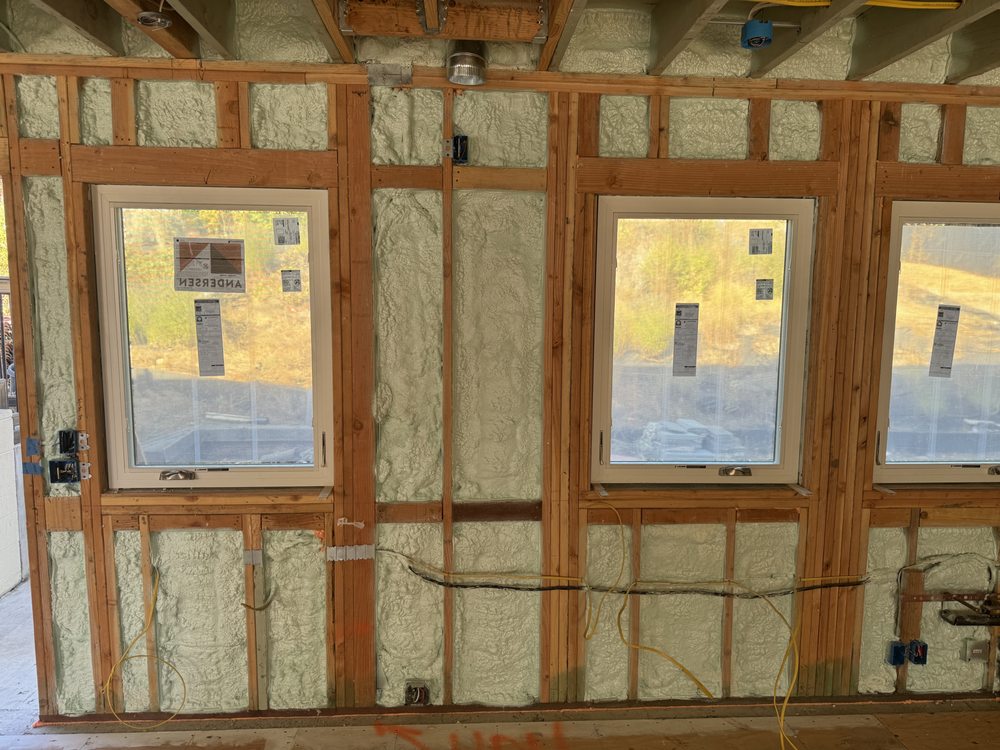
Flash-and-batt is the hybrid wall system contractors bring up when full spray foam doesn’t fit the budget: spray a “flash” layer of closed-cell foam against the sheathing, then fill the rest of the stud cavity with a fiberglass or mineral-wool batt. Foam where it matters, cheap fluff for the rest. It’s a legitimate system — but in Fargo’s Climate Zone 7, it has one failure mode you need to understand before you sign a bid.
Short version: Flash-and-batt works in North Dakota only if the closed-cell layer is thick enough — roughly 50% of the wall’s total R-value, which in a Zone 7 2x6 wall means about 3 inches of foam, not the 1-inch “skim coat” some bids spec. Too thin, and warm indoor moisture condenses on the cold foam face inside your wall all winter. Done right, it costs meaningfully less than full closed-cell with most of the performance. Done cheap, it’s a hidden mold problem.
Why the foam thickness is everything
The physics is simple: in January, the outer part of your wall is nearly as cold as the outdoors, the inner part is room temperature, and somewhere in between is the dew point — the surface where moisture in the air condenses.
In a flash-and-batt wall, the inside face of the foam layer is a condensing surface, because batts let indoor air (and its moisture) reach it. The design rule that keeps you safe: the foam needs enough R-value to keep its inner face above the dew point through the winter. In Climate Zone 7 — the coldest zone in the lower 48, which covers Cass County and all of the Fargo-Moorhead area — building-science guidance puts that at about half the total cavity R-value in the foam layer.
Run the numbers on a 2x6 wall targeting ~R-21+: roughly R-10 to R-11 must come from foam. Closed-cell runs R-6 to R-7 per inch, so that’s about 3 inches of foam plus a thinner batt — not 1 inch of foam and a fat batt. A 1-inch flash (~R-6.5) against a full batt in a Fargo winter leaves the foam face below the dew point for weeks at a time. Moisture accumulates in the batt and against the foam, and because it’s inside the wall, you won’t see it until it’s drywall-and-framing repair.
This is the same moisture logic we walk through in spray foam, moisture, and vapor barriers in North Dakota homes — Zone 7 punishes assemblies that would be fine in Kansas.
What a good flash-and-batt bid looks like here
If you’re comparing quotes for a new build or a gut-remodel around Fargo, West Fargo, or Moorhead, a Zone 7-appropriate flash-and-batt spec should show:
- Foam thickness in inches, in writing — for 2x6 walls, ~3 inches of closed-cell (roughly R-19 to R-21 from foam alone); more conservative is fine, thinner is not.
- Closed-cell, not open-cell, for the flash layer — the flash has to be the vapor control layer, and only closed-cell qualifies at these thicknesses.
- A snug batt filling the remaining depth with no air gap between batt and foam — a gap creates a convection loop that undercuts both layers.
If a bid can’t tell you the foam thickness, or specs an inch “to air-seal,” it’s pricing a warm-climate detail for a -20°F town.
Flash-and-batt vs. full foam: the honest trade
At the correct Zone 7 thickness, flash-and-batt genuinely saves money versus filling the cavity with foam, and you keep the two things foam does best: the air seal at the sheathing and the vapor control. Full wall-cavity spray foam still wins on simplicity (one trade, one inspection, nothing to fit wrong), slightly better whole-wall R per inch, and zero dependence on batt installation quality — batts installed with gaps and compressions are the most common defect we see opening up walls. It’s the same theme as spray foam vs. fiberglass generally: the material is only as good as the air-sealing around it.
Where the cavity is shallow — rim joists, 2x4 walls in older Fargo homes — skip the hybrid and go full closed-cell; there isn’t enough depth to split between two materials safely.
Comparing bids for a build or remodel? Request a free quote and we’ll price both assemblies for your actual wall depth — with the foam thickness spelled out in inches, so you can compare apples to apples.